.png)
About LUNG LINK
LUNG LINK, short for Localized Network for Lung Health in Northeast Texas, is a partnership between The University of Texas Health East Texas, Family Circle of Care, and The University of Texas MD Anderson Cancer Center.
Our mission is to increase access to lung cancer screening for people in Northeast Texas who may be at higher risk due to current or past cigarette use by:
-
Raising awareness
-
Promoting prevention and early detection
-
Helping people connect with screening, treatment, and support services
Through LUNG LINK, providers guide patients through shared decision-making to determine if lung cancer screening is right for them. Providers then refer patients who are interested and eligible for lung cancer screening, as well as offer support for those who are interested in tobacco treatment.
Components of LUNG LINK
Lung Cancer Screening
Lung cancer screening is a routine preventive health check, much like a colonoscopy or mammogram. Screening helps find lung cancer at an early stage when it is small and more likely to be treated successfully. Lung cancer screenings have been shown to lower the risk of dying from lung cancer.
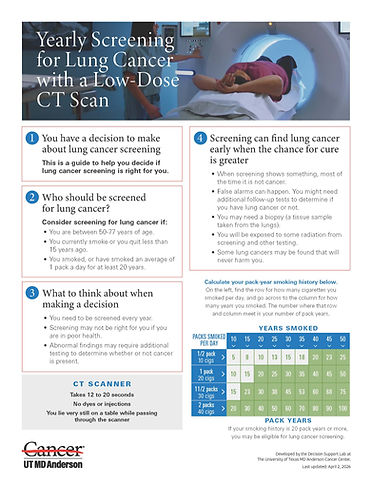
Lung cancer screenings are conducted through a low dose computed tomography (LDCT) scan, which uses a very small amount of radiation to look for abnormal areas in the lungs that could be cancer.
To qualify for lung cancer screening, a person must:
-
Be 50-80 years old (50-77 for Medicare coverage)
-
Currently smoke or have quit smoking in the past 15 years
-
Have a 20 pack-year smoking history
-
To calculate your pack-years:
-
Multiply the number of packs you smoke per day by the number of years you've smoked
-
-
If you're ready to schedule a lung cancer screening or would like more information, contact your primary care provider. Current UT Health East Texas patients can call 903-877-7008 or visit the UT Health East Texas website to schedule an appointment. Current Family Circle of Care patients can call 903-535-9041 for assistance.
Watch the videos below to learn what to expect and feel more confident talking with your primary care provider about whether lung cancer screening is right for you.


Shared Decision-Making
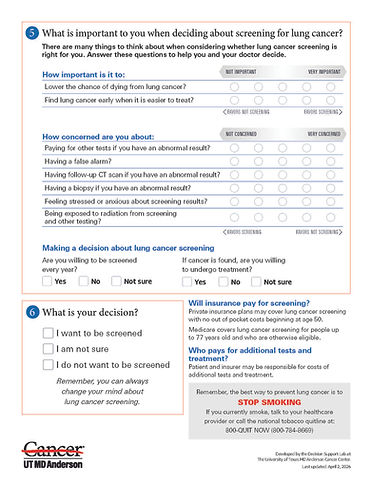
Talking with your provider is an important part of deciding whether lung cancer screening is right for you. These conversations, called shared decision-making, give you the chance to ask questions, understand your options, and make a choice that fits your needs and preferences.
Your provider will explain the potential benefits and risks of screening, often using a decision aid like the one you see below to make the information easier to understand and help you make an informed choice.
Tobacco Treatment
The best way to quit tobacco is by using FDA-approved medication and getting support from a counselor.
-
Talk to your doctor about treatment options.
-
Call 1-800-784-8669 (1-800-QUIT-NOW) for your state's tobacco quitline.
-
Text EXPROGRAM to 88709 for free 24/7 texting support.
-
Visit SmokeFree.Gov for more information.
Not ready to quit, but want to try cutting back or getting ready to quit?
-
Text GO to 47848 and join a daily challenge program from SmokeFree.Gov that helps you learn your triggers, handle cravings and build the skills and confidence to quit when you're ready.